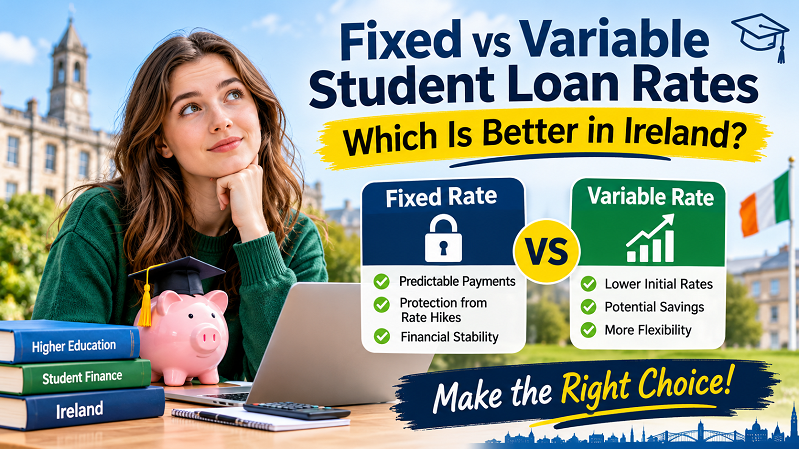
Paying for higher education can be challenging, particularly when tuition fees, accommodation, books and everyday living expenses start adding up. While scholarships, student grants, savings, and part-time work can help cover some of these costs, many students still need additional financial support.
A student loan in Ireland can help bridge this funding gap when other financial resources are not enough. However, before applying, it is important to understand the borrowing costs and repayment conditions.
One of the biggest decisions you may face is choosing between a fixed and variable interest rate. Both options have advantages and disadvantages, and the right choice depends on your financial circumstances, repayment capacity, and comfort with interest-rate changes.
So, which option makes more sense for students in Ireland? Let's explore how fixed and variable student loan rates work, compare their benefits and drawbacks, and understand what to consider before borrowing.
Before looking at each option in detail, here is a quick comparison of fixed and variable student loan interest rates.
| Comparison factor | Fixed interest rate | Variable interest rate |
| Interest rate | Remains unchanged during the agreed fixed period | Can increase or decrease |
| Monthly repayments | Generally predictable | May change when the rate changes |
| Budget planning | Easier to plan | Requires financial flexibility |
| Rising interest rates | Protection during the fixed period | Repayments may increase |
| Falling interest rates | No automatic benefit | May benefit from lower rates |
| Financial risk | Lower exposure to interest-rate changes | Higher exposure to interest-rate changes |
| Suitable for | Borrowers who value repayment stability | Borrowers comfortable with changing repayments |
Important: Actual loan conditions vary between lenders. Check whether a fixed rate applies throughout the entire repayment term or only for a specified period.
A fixed interest rate remains unchanged throughout the agreed fixed-rate period. This means the interest rate applied to your outstanding loan balance will not increase or decrease during that period, even if wider market interest rates change.
For students who prefer predictable borrowing costs, a fixed-rate loan can make financial planning easier.
One of the biggest advantages of a fixed-rate student loan is repayment predictability.
If your loan has a fixed rate and an agreed repayment schedule, you generally know how much you need to pay each month. This makes it easier to organise your finances, particularly when managing rent, groceries, transport and other education-related expenses.
Interest rates can change because of wider economic conditions and monetary policy decisions.
With a fixed-rate loan, you are protected from interest-rate increases during the agreed fixed period. Even if market rates rise, your contractual interest rate remains unchanged.
This can be particularly useful if you have a limited monthly budget and want to avoid unexpected increases in your borrowing costs.
Knowing your repayment amount in advance can help you plan your finances more confidently.
For example, if you are expecting to start full-time employment after completing your course, having a predictable repayment schedule may make it easier to estimate your future financial commitments.
Fixed rates also have some limitations that borrowers should understand.
Depending on the lender and market conditions, fixed-rate loans may have higher starting interest rates than variable-rate alternatives.
However, this is not always the case. You should compare the actual interest rates and APRs rather than assuming one option will always be cheaper.
If market interest rates decrease after you take out a fixed-rate loan, your existing interest rate will generally remain unchanged during the fixed period.
As a result, you may miss out on potential savings available to borrowers with variable-rate loans.
Some lenders may apply early repayment charges or other conditions when borrowers repay a fixed-rate loan ahead of schedule.
Before signing an agreement, check whether you can make additional payments or settle the outstanding balance early without incurring extra costs.
A variable interest rate can increase or decrease during the repayment period. Unlike a fixed-rate loan, the interest charged on your outstanding balance may change according to the lender's pricing arrangements and the terms of your agreement.
Some variable rates are linked to reference rates, while others are adjusted by lenders according to their own pricing policies.
This means your monthly repayments or the total interest you pay may change over time.
Some variable-rate loans may offer lower initial interest rates than fixed-rate alternatives.
This can make them attractive to borrowers who want to reduce their initial borrowing costs.
However, a lower starting rate does not guarantee that the loan will remain cheaper throughout the repayment period.
One of the main advantages of variable interest rates is the possibility of benefiting from lower rates.
If your lender reduces the applicable interest rate, your monthly repayment or total interest cost may decrease, depending on the loan agreement.
This could help you save money over the repayment period.
Some variable-rate loan products offer more flexibility around additional repayments or early settlement.
However, this depends entirely on the lender's terms. Do not assume that every variable-rate loan allows penalty-free early repayment.
The biggest disadvantage of a variable-rate loan is uncertainty.
If your lender increases the interest rate, your monthly repayments may also increase. This can make budgeting more difficult, especially if you have limited income.
Variable interest rates can increase as well as decrease.
If rates rise significantly during your repayment period, you could end up paying more interest than you initially expected.
A loan that appears affordable when you apply may become more expensive over time.
Unexpected repayment increases can put additional pressure on students and recent graduates.
If you are already managing accommodation costs, transport, food and other financial commitments, even a modest increase in your monthly loan repayment could affect your budget.
For this reason, it is important to consider whether you could comfortably afford the loan if interest rates increased.
Understanding the impact of interest-rate changes is important before choosing a variable-rate loan.
Consider a hypothetical example:
Suppose you borrow €5,000 to cover education-related expenses. Your loan has a variable interest rate and a repayment period of three years.
Initially, the interest rate is relatively low. However, after the first year, your lender increases the applicable rate.
Depending on the repayment arrangement, your monthly instalments could increase, or a larger proportion of your repayments could go towards interest.
On the other hand, if the interest rate decreases, you may benefit from lower borrowing costs.
This example highlights why you should not choose a variable-rate loan based only on its initial interest rate.
Practical tip: Before applying, ask your lender what would happen to your monthly repayments if the interest rate increased by one or two percentage points. This can help you understand whether the loan would remain affordable.
This is an illustrative scenario, not a lender quotation. Actual repayments depend on the interest rate, APR, fees, repayment frequency, and loan agreement.
Interest rates are important, but they are not the only factor to consider when comparing student loan options.
You should also understand the Annual Percentage Rate (APR).
APR represents the annual cost of borrowing, expressed as a percentage. It generally includes the interest rate and certain compulsory charges associated with the loan.
When comparing personal loans or education-related borrowing in Ireland, looking at APR can give you a more useful indication of the overall borrowing cost than comparing advertised interest rates alone.
For example, two lenders might advertise similar interest rates but have different compulsory fees. Their APRs and total repayment amounts could therefore differ.
Before making a decision, compare:
Remember that APR is based on specified assumptions and does not necessarily predict the future cost of a variable-rate loan.
A fixed-rate student loan may be suitable if you prefer stability and want greater certainty about your monthly financial commitments.
You might consider this option if:
Many students and recent graduates appreciate the peace of mind that comes with having a predictable repayment schedule.
However, always compare the fixed-rate offer with other available options before making a decision.
A variable-rate student loan may be appropriate for borrowers who understand the risks and have enough financial flexibility to manage changing repayments.
You might consider this option if:
It is important not to choose a variable rate simply because you expect market interest rates to decrease. Future interest-rate movements are difficult to predict.
Your decision should be based on what you can afford, even if borrowing costs increase.
Some borrowers may want to change their interest-rate arrangement if their financial circumstances or market conditions change.
However, switching from a variable to a fixed rate is not automatically available with every lender.
Whether you can change your rate will depend on your loan agreement and the lender's policies.
Before taking out a loan, ask:
If switching is not available, refinancing may be another possibility. However, refinancing involves taking out a new borrowing arrangement and should only be considered after comparing the costs, eligibility requirements and total amount repayable.
Choosing between fixed and variable interest rates is only one part of the borrowing decision.
If you are considering a student loan or personal loan in Ireland to fund education expenses, take time to review the following factors.
Before borrowing, check whether you qualify for student grants, scholarships, bursaries, or other education funding.
For eligible students, schemes such as SUSI may provide financial assistance towards approved education costs.
Reducing the amount you need to borrow can help lower your future repayment commitments.
Different lenders have different eligibility criteria.
Depending on the loan product, they may consider your age, residency, income, employment status, credit history, and ability to repay.
Some lenders may also require a guarantor or additional financial information.
Do not select a loan simply because it offers the lowest advertised interest rate.
Compare the APR, monthly instalments, applicable fees, and total amount repayable over the full term.
Check whether the lender allows additional repayments, early settlement, or changes to your repayment schedule.
Also ask whether any charges apply when you make additional payments.
It can be tempting to borrow more than necessary when additional funds are available.
However, a larger loan means more money to repay and potentially more interest over time.
Calculate your actual education expenses before deciding how much to borrow.
There is no single answer to whether fixed or variable student loan rates are better. The right option depends on your financial situation, repayment capacity, and willingness to accept changes in borrowing costs.
A fixed-rate student loan may be a better fit if you prioritise predictable repayments and want protection against interest-rate increases during the agreed fixed period.
A variable-rate loan may be worth considering if you can manage repayment uncertainty and want the possibility of benefiting from lower interest rates.
If you are planning to take out an online loan in Ireland to cover education expenses, compare different lenders, review the APR and understand the repayment conditions before applying.
Most importantly, do not borrow more than you can comfortably repay. A student loan should support your education goals without creating unnecessary financial pressure after graduation.
A fixed interest rate remains unchanged during the agreed fixed period, making repayments more predictable. A variable interest rate can increase or decrease depending on the lender's pricing arrangements and loan terms, potentially changing your monthly repayments and total borrowing costs.
A fixed rate may suit borrowers who prefer stable repayments and predictable borrowing costs. A variable rate may suit those who can manage repayment increases and are comfortable with potential interest-rate changes. Neither option is universally better.
Yes. Variable interest rates can increase or decrease during the loan term. If the applicable rate increases, your monthly repayments or total interest costs may also rise, depending on your agreement.
No. A fixed rate provides greater certainty about the interest rate during the agreed period, but it does not guarantee the lowest overall borrowing cost. The total cost also depends on the loan amount, APR, repayment term, and applicable fees.
Early repayment may be possible, but the conditions depend on the lender and loan agreement. Some products allow additional repayments without charges, while others may apply early settlement fees. Check the terms before signing.
Students with a poor credit history may face additional borrowing restrictions. Approval depends on the lender's eligibility criteria, income assessment, credit history, and ability to repay. Not every lender offers both fixed and variable options.
You should compare APR, total repayment costs, monthly instalments, repayment duration, compulsory fees, early repayment conditions and any available repayment flexibility.
Grants generally do not need to be repaid when the recipient meets the scheme's conditions, whereas loans must be repaid with any applicable interest and charges. Eligible students should explore available grants and scholarships before considering borrowing.
Financial information disclaimer: This article is for general educational and informational purposes only. It does not constitute financial advice or a recommendation to take out a particular loan. Loan availability, interest rates, eligibility criteria, and repayment conditions vary between lenders. Always review the loan agreement and consider your financial circumstances before borrowing.

Kiera Naylor is the Finance Content Manager at MyCreditBucks, where she helps readers make sense of personal finance, borrowing options and loan-related topics. She focuses on creating clear, practical and reader-friendly content that explains loan costs, repayment terms, eligibility requirements and responsible borrowing.
Kiera believes that understanding your financial options is an important step towards making informed borrowing decisions. Through her work at MyCreditBucks, she aims to make financial information easier to understand and help readers explore their options with greater confidence.
