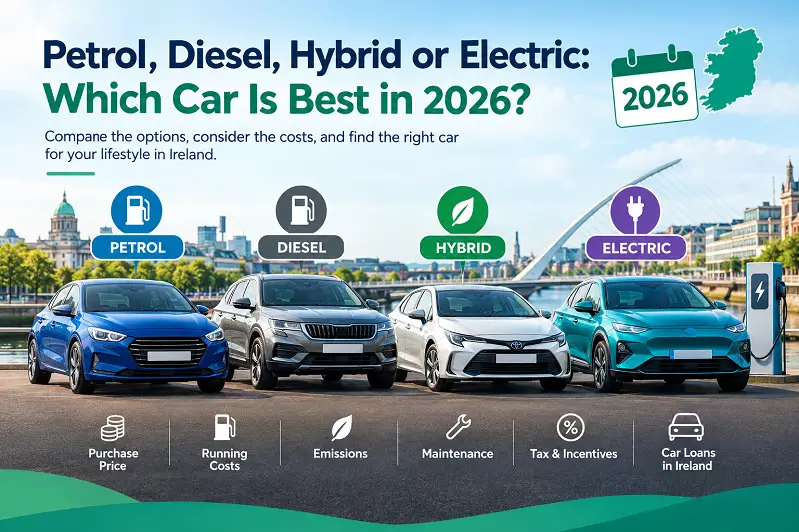
Choosing a car in Ireland in 2026 involves more than looking at how much it costs to buy. Fuel costs, how many miles you drive each year, motor tax, maintenance, emissions, and where you can charge a car can all affect how much it costs to own a vehicle. There are petrol, diesel, hybrid, and electric cars at different prices. Picking the one means thinking carefully about what you need.
For some people, a petrol car might be a way to get a car without spending too much. Others might find that a diesel or hybrid car is better because it can save on fuel. An electric car might work well for people who have a place to charge it and don't drive far each day.
The best choice depends on what you need and how much you can afford. What you expect in the future. This guide looks at the bad parts of each type of car in Ireland. It also explains what to think about before you buy and how car loans can help you pay for your car.
There is no answer that works for everyone. Before you choose a car, think about how far you drive, where you drive, how much you can spend up front, and what you expect to pay for running the car.
For example, a person who drives in the city and has a place to charge a car might find an electric car to be a choice. Someone who drives a lot on trips might want to look at diesel, hybrid and electric cars. A buyer who does not have a lot of money to spend at first might find a used petrol car to be a choice.
Here is a quick comparison.
Factor | Petrol | Diesel | Hybrid | Electric |
Purchase price | Often competitive, especially for used cars | Depends on model, age and condition | Often higher than comparable petrol models | Can be higher, although used options vary |
Running costs | Depend on fuel economy and petrol prices | May suit high-mileage drivers | Can reduce fuel consumption | Can be lower with affordable charging |
Refuelling or charging | Widely available petrol stations | Widely available diesel stations | Fuel stations; plug-in hybrids can also charge externally | Home or public charging |
Maintenance | Depends on model and condition | Depends on model and condition | Depends on the hybrid system | Often less routine drivetrain maintenance |
Main consideration | Fuel expenditure and emissions | Mileage and maintenance | Purchase price and hybrid type | Charging access and battery condition |
These are general comparisons and not guarantees. The real cost of owning a car depends on how much it costs to buy, how many miles you drive each year, energy prices, insurance, maintenance, and how much the car loses in value over time.
Petrol cars are still a choice for many people in Ireland, especially if you are looking for a used car or a model that is easy to buy. They are available in sizes from small cars for the city to larger ones for families.
Advantages of petrol cars
• Lower prices: Many petrol cars are available at a low price, especially if you buy a used one.
• Easy to refuel: Petrol stations are everywhere in Ireland, which makes long trips easier to plan.
• choices: You can pick from a wide range of models, sizes and features.
• repairs: Many garages can fix cars that run on petrol.
Disadvantages of petrol cars
• fuel: Buying petrol can cost a lot especially if you drive a lot each year.
• Pollution: Petrol cars send out carbon dioxide and other harmful gases.
• Possible loss of value: The value of your car might go down because of rules and new types of cars.
Petrol cars could be an idea if you want to save money at first and don't drive very far. Don't just look at the price. Think about how much you will spend on fuel each year. Compare that with what you could save by buying an electric car.
Diesel cars have been popular with people who drive long distances. They can save fuel on trips, but they are not always the cheapest option.
Advantages of diesel cars
• Fuel economy: Some diesel cars are good at saving fuel when you drive long distances.
• for high mileage: If you drive a lot a diesel car might be a good choice.
• Used cars: You can find used diesel cars for different budgets.
Disadvantages of diesel cars
• repairs: Fixing parts like the diesel filter can cost a lot.
• Pollution: Diesel cars send out nitrogen oxides and other bad gases.
• Changing demand: The value of diesel cars depends on the model, rules, and how many people want them.
• trips: Some diesel cars are not good for regular short trips.
Diesel cars might make sense if you drive a lot. You should compare the total cost with petrol, hybrid, and electric cars. Not all diesel cars will disappear from the roads soon. Rules about cars don't mean old ones have to be taken off the road. If you plan to keep a car for a year, think about the rules, how far you drive, and what it will cost to run.
Hybrid cars use both an engine and an electric motor. They can help save fuel without needing to charge every time.
There are two kinds of hybrids.
• Standard hybrid: The battery is recharged by the car, including when you brake. You still need to fill up with fuel.
• Plug-in hybrid: The battery can be charged from outside, so you can drive some trips on electricity before the engine starts.
Advantages of cars
• Saving fuel: Hybrid cars can save fuel especially in busy traffic.
• Pollution: Some hybrids have lower emissions depending on how they are used.
• Convenience: Standard hybrids do not need a charging point.
• Flexibility: Plug-in hybrids let you drive on electricity for trips while using the engine for longer ones.
Disadvantages of cars
• Higher price: Some hybrid cars cost more than similar petrol cars.
• Parts: Hybrids have both electric and fuel parts, so repairs can vary in cost.
• Benefits: Plug-in hybrids might not save much fuel if you don't charge them often.
• Battery condition: If you buy a used hybrid, check the battery history, warranty, and how it is working.
Hybrids can be a choice if you want to save on fuel but can't charge an electric car. Compare the plug-in versions carefully because they can be very different in how much they cost and how much they save.
Electric cars are becoming more common in Ireland. According to the Central Statistics Office, electric cars made up 42% of cars registered in September 2026. The number of electric cars sold that month was 54% higher than in September 2025.
This shows that electric cars are becoming more important. That does not mean they are the best choice for everyone.
Advantages of cars
• No air pollution: Electric cars do not send out any harmful gases while driving.
• Energy costs: Charging can be cheaper, especially if you have a good electricity rate.
• Maintenance: Electric cars have fewer parts to fix in the engine.
• Ride: Electric cars are quieter than petrol and diesel cars.
• Possible tax and money help: Some electric cars can get money from the government if you meet the rules.
Disadvantages of cars
• Higher price: Some electric cars cost more than similar petrol cars.
• Charging: If you do not have a place to charge you may need to use chargers.
• Planning: You need to think about how it takes to charge, where the chargers are and how far you can go.
• Battery issues: The battery may not work well over time, and fixing it can be expensive.
• Loss of value: How much the car is worth later depends on how many people want it and how good the battery is. New car prices.
The price of the car is one part of the cost. Compare the cost of charging, insurance, motor tax, and how much the car loses in value with the costs of a petrol or diesel car.
Some people may get money from the government for buying a car. For example, the Sustainable Energy Authority of Ireland gives up to €3,500 for an electric car if you meet the rules. Used electric cars do not get this money.
The money you can get may change, so check the rules before you buy.
For a used car, ask for a report on how good the battery is, check the battery warranty, and look at the service history. These steps can help you understand what the car will cost in the future.
The government may give money to help you buy a car but not everyone is eligible. The help you get depends on the car how much it costs, how you buy it and the rules, at the time.
Before including an incentive in your budget check:
• Whether the vehicle qualifies for the purchase grant.
• Whether the grant applies to a new car or a used vehicle.
• The price limits and other eligibility requirements.
• The applicable vehicle registration tax (VRT) relief if any.
• The motor tax rate for the vehicle.
• Whether home-charger support is available for your circumstances.
For information, consult the SEAI electric vehicle grant guidance and Revenues guidance on VRT for electric vehicles.
Do not base your decision solely on a headline grant amount. Work out the purchase price after any confirmed incentives and compare the total ownership cost with other vehicles.
A car that costs less to buy is not necessarily cheaper to own. Likewise, a vehicle with monthly energy costs may have a higher purchase price or insurance premium.
Before choosing a model, estimate the following expenses.
1. Purchase price and deposit
Decide how much you can afford upfront without using money needed for household expenses or emergencies.
2. Fuel or charging
Estimate your mileage and likely fuel or electricity consumption. For an EV, compare home and public charging costs if both are relevant.
3. Insurance and motor tax
Obtain insurance quotes for the vehicle and check its applicable motor tax rate before buying.
4. Servicing and repairs
Consider maintenance, tyres, brakes, wear-and-tear items, and possible repairs. If buying a used vehicle, a history check and independent inspection may help identify problems.
5. Depreciation and resale value
Consider how age, mileage, condition, model popularity, and future market demand may affect the vehicle's value when you sell it.
6. Financing costs
If you borrow to buy the car, compare the APR, monthly repayment, loan term, fees, and total amount repayable. A longer term may reduce payments but can increase the total interest paid.
Comparing these costs gives you a more realistic view of affordability than looking at the purchase price or monthly repayment alone.
Once you have chosen a vehicle and worked out your budget, the next step is to compare your financing options. In Ireland, buyers may consider a loan, hire purchase (HP), or a personal contract purchase (PCP).
Each option works differently. The right choice depends on your financial circumstances and ownership preferences.
With an ordinary unsecured personal loan, you generally borrow the money and purchase the vehicle directly. You normally own the car from the point of purchase while repaying the loan under the agreed terms.
A personal loan may suit buyers who want flexibility over their choice of vehicle. However, approval, interest rates, loan amounts, and repayment terms depend on the lender's criteria and your ability to repay.
Under a hire purchase agreement, you generally make a deposit followed by scheduled payments. Ownership usually transfers after the agreement's conditions have been met and the required final payment has been made.
PCP typically involves a deposit, monthly payments, and a final payment if you want to own the vehicle at the end of the agreement. Depending on the contract, you may have options, such as returning the car, subject to the agreement's conditions.
There is no cheapest option. Compare each product using the vehicle price and where possible comparable repayment periods.
| What to compare | Why it matters |
| APR and interest rate | Helps you understand the cost of borrowing |
| Monthly repayment | Shows whether payments fit your budget |
| Total amount payable | Helps compare the overall cost, including applicable charges |
| Deposit and fees | Shows how much you need upfront |
| Loan term | A longer term may reduce monthly payments but increase total interest. |
| Ownership conditions | Determines when you own the vehicle and what happens at the end of the agreement |
| Early repayment terms | Helps you understand whether you can repay early and whether charges apply |
A car loan can spread the purchase cost over an agreed period, but borrowing adds interest and may involve fees. Before applying, check the lender's eligibility requirements, assess your budget, and make sure you can manage repayments alongside your other commitments.
If you are exploring financing for your vehicle, you can review MyCreditBucks car loan options. Check the product terms, applicable rates, eligibility criteria, and total repayment cost before deciding whether to apply.
The suitable car depends on how you drive, what you can afford, and what is practical for your circumstances.
• Choose petrol if you want to compare purchase prices and prefer the convenience of widespread refuelling.
• Consider diesel if you regularly cover distances and the vehicle's fuel economy makes financial sense for your annual mileage.
• Consider a hybrid if you want to improve fuel efficiency but do not want to depend on charging.
• Consider a car if you have practical charging arrangements and its purchase price, range, and running costs fit your needs.
Before making a final decision, compare specific vehicles rather than relying only on general differences between fuel types. A maintained used car may suit your budget better than a more expensive alternative, while an EV with convenient home charging may offer attractive running costs for another household.
If you plan to finance the purchase, compare the vehicle's ownership costs with the cost of borrowing. Choosing a car that fits both your driving habits and your repayment capacity can help you avoid financial pressure.
1. Which car is cheapest to run in Ireland in 2026?
An electric car can be cheaper to run than a petrol or diesel vehicle, particularly when home charging is available at an affordable rate. However, purchase price, insurance, public charging, depreciation, and annual mileage also matter. Compare the cost of ownership before deciding.
2. Are cars a good choice for Irish drivers?
They can be, for drivers with convenient charging access and predictable daily journeys. Before buying consider driving range charging availability, longer journeys, battery warranty and the overall purchase cost.
3. Are cars better than petrol cars?
Not in every situation. Hybrids may use fuel in stop-and-go traffic, but they can cost more to buy. Compare the price, expected fuel consumption, maintenance, and annual mileage to determine which option is better for you.
4. Is diesel still worth buying in Ireland?
Diesel may suit drivers who cover distances regularly, but it is not automatically the cheapest choice. Consider fuel economy, emissions, maintenance requirements, vehicle age, and potential resale value before purchasing.
5. What incentives are available for cars in Ireland?
Eligible new battery-electric cars may qualify for SEAI purchase grants, and certain vehicles may benefit from tax reliefs. The amount and eligibility requirements vary, so check the official rules before including incentives in your budget.
6. How can I finance a car in Ireland?
You can compare loans, hire purchase, and personal contract purchase. Review the APR, deposit, payments, total amount payable, repayment term, and ownership conditions. A lender will assess your application against its criteria, and approval is not guaranteed.
7. Are electric cars reliable than petrol and diesel cars?
Electric cars have moving parts in their drivetrains and may require less routine maintenance. However, reliability varies by model, age, battery condition, and build quality. Check the vehicle's history and warranty rather than assuming every EV will be more reliable.
Petrol, diesel, hybrid and electric cars each have advantages and disadvantages. The best choice in 2026 is not necessarily the technology or the car with the lowest advertised price. It is the vehicle that fits your driving habits, budget and long-term plans.
Compare the purchase price, fuel or charging costs, insurance, maintenance, motor tax, and expected depreciation before making a decision. If you need finance, compare car loan options and look beyond the monthly repayment to the total amount you will pay.
With research and realistic budgeting you can choose a car that meets your everyday needs without placing unnecessary pressure on your finances.

Kiera Naylor is the Finance Content Manager at MyCreditBucks, where she helps readers make sense of personal finance, borrowing options and loan-related topics. She focuses on creating clear, practical and reader-friendly content that explains loan costs, repayment terms, eligibility requirements and responsible borrowing.
Kiera believes that understanding your financial options is an important step towards making informed borrowing decisions. Through her work at MyCreditBucks, she aims to make financial information easier to understand and help readers explore their options with greater confidence.
