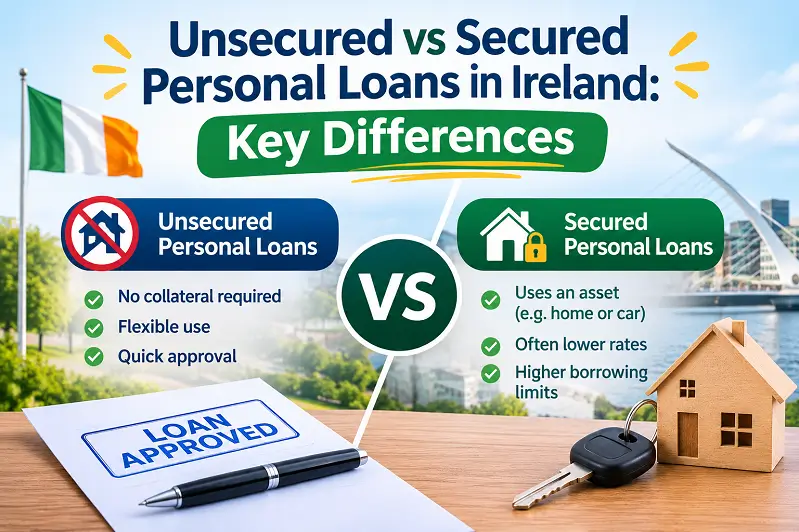
The major factor that distinguishes these two loans is the involvement of collateral. One requires you to pledge assets to qualify and get approved for a larger amount. Conversely, the other does not demand collateral to issue funds in a smaller amount.
Understanding the differences can help in making a better choice. Moreover, you will be aware that a lack of assets will not automatically disqualify you from loans. A clear example of this is a financing option like unsecured personal loans in Ireland.
Therefore, if you have a trivial requirement for funds, there is no need for you to risk assets. Based on your affordability and eligibility, you can get access to smaller amounts, offered for shorter terms.
This is a borrowing arrangement that does not require any asset as security for the debt. Funds are usually offered based on your affordability and financial circumstances. Your net income, expenses, and obligations are evaluated before deciding whether or not to approve loans.
Key features of unsecured funding are:
These borrowing options provide access to larger amounts of funds against collateral you have pledged. Depending on the loan agreement, you can use assets like a home, car, etc. to apply for loans.
Here, you are putting your assets at risk to get a sizeable loan amount. At the same time, you can tap into better terms and rates. However, failing to repay may cost you more than what you have borrowed. You will lose your assets forever, as they will be used by lenders to recover the unpaid loan amount.
Key features obtainable with secured loans are:
Both offer access to funds, but their way of working, terms, and conditions will vary. Here are the ways that differentiate these two funding options.
When you opt for unsecured funding, you do not have to worry about pledging assets. These loans are accessible to tenants and non-homeowners as well. Conversely, a secured loan option will require you to pledge assets in order to qualify for a loan application.
When assets are involved, the lender agrees to offer a larger borrowing limit. However, there is no guarantee that you will get approval for the preferred amount. The repayment term for secured loans is going to be longer, unlike unsecured loans.
This means that you will have to keep paying off loans for several years. Although this can disrupt major financial goals, it can help you address expensive repairs. On the other hand, secured loans let you pay back money within a shorter duration by paying small instalments.
The involvement of assets can work in your favour in getting lower rates. This is mainly because the lender knows that they can recover the offered amount even if you default on the loan.
This is not possible with unsecured funding. For this reason, the rates might be high to counter the risk involved in the lending process. However, they allow you to repay faster than secured funding.
As a result, the total borrowing cost will be lower for the collateral-free borrowing option. Because of the stretched repayment term, you keep paying interest for a longer duration. This is responsible for increasing the overall cost of borrowing for secured loans.
Getting a personal loan in Ireland is possible with or without assets. All you need to do is understand the differences. Most importantly, acknowledge how one form of funding may be beneficial over the other.
Do not just focus on whether or not assets are involved. Assess the cost and other features of these two loans. Find out how a particular financing option may be suitable for your situation.
Understand what kinds of requirements will be addressed by unsecured and secured loans. Otherwise, you might end up choosing the wrong loan option.
How much should you borrow?
It depends on the borrowing limits provided with the loan options. For example, you get an opportunity to borrow larger amounts with secured loans and vice versa. Find out how much you need and how much you can actually afford to repay.
Are unsecured loans more expensive than secured loans?
Yes, as they do not involve assets, which can reduce lending risk. Moreover, interest rates charged by different lenders are going to be different. The borrowing amount may also increase or decrease the interest rates. Lastly, the length of the repayment term also influences the borrowing cost.

Kiera Naylor is the Finance Content Manager at MyCreditBucks, where she helps readers make sense of personal finance, borrowing options and loan-related topics. She focuses on creating clear, practical and reader-friendly content that explains loan costs, repayment terms, eligibility requirements and responsible borrowing.
Kiera believes that understanding your financial options is an important step towards making informed borrowing decisions. Through her work at MyCreditBucks, she aims to make financial information easier to understand and help readers explore their options with greater confidence.
