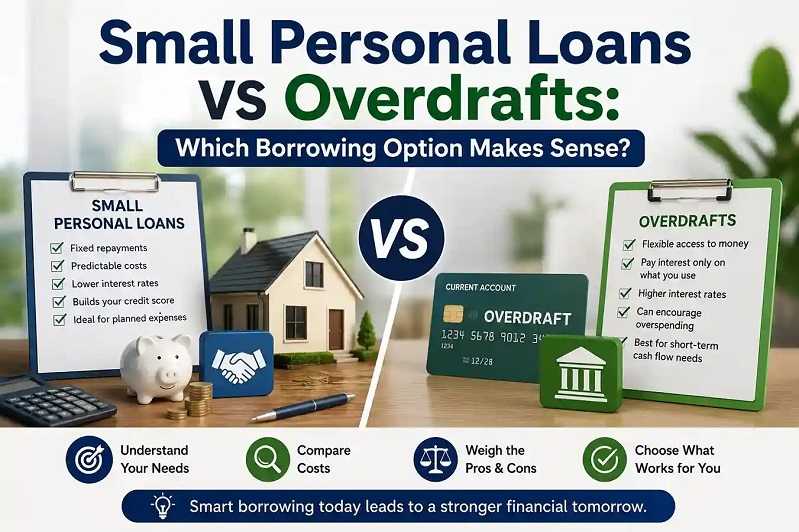
Both small personal loans and overdrafts provide quick access to cash, but which one of them makes sense in a specific situation boils down to multiple factors ranging from flexibility to repayment costs.
Small personal loans in Ireland are unsecured loans provided by banks, credit unions and direct lenders. A lump sum is borrowed and paid back in fixed instalments over an extended period of time, typically between 6 months and 5 years, depending on factors such as your credit history, financial condition, and the loan amount.
Here are the features of personal loans:
An overdraft is a facility that banks provide to their customers. It is a facility to withdraw more money than you currently have in your account, up to a pre-approved limit. An overdraft is like revolving credit. Once you repay the amount, you can reborrow. However, you cannot withdraw more than the given limit.
Benefits
The biggest benefit is predictable payments. When you know how much amount of money you need to pay, you can easily create your budget. It reduces your chances of missing a payment. As a result, your credit score remains protected.
Small loans in Ireland charge lower interest rates than overdrafts. However, you should still compare the cost of both options, because the repayment duration can affect the total cost of a personal loan.
If your credit rating is compromised and you want to improve it, personal loans can come in handy. They are repaid over an extended period of time. This proves your loyalty towards payments. If you manage to repay the whole debt, this will certainly improve your credit score. However, bear in mind that late payments can damage your credit score.
You can borrow a large sum of money, ideal for funding large expenses such as a wedding, home repairs and debt consolidation.
Limitations
The repayment term and monthly instalments will remain unchanged. Even if your financial condition has turned upside down, you will need to adhere to the existing repayment plan.
Personal loans in Ireland are not immediately approved. Lenders run affordability checks, which include credit checks and income evaluation. This process takes some days to complete.
Upsides
The biggest benefit of overdrafts is that they are flexible. They are similar to a revolving credit. You can withdraw funds up to a limit as and when you need them. Interest will be accrued on the unpaid balance. Unlike personal loans, there is no fixed schedule. They are more flexible on repayments than personal loans.
If you need funds this instant, you can apply for overdrafts. You can access funds as soon as the facility is approved. Because of the quick funding, they are ideal for funding small emergency expenses.
Risks
Interest rates for overdrafts are quite high. You will find them more expensive than personal loans, especially if you use them for a long period of time. The sooner you pay off overdrafts, the better it is.
Since they are easily accessible, there is a high chance that you rely on them to cover small emergencies now and then instead of setting aside money for them. Over-reliance on them can ruin your financial condition.
An overdraft facility does not come with larger limits. If you need a large sum of money, personal loans will be a better choice.
There is no straightforward answer to this question, as it comes down to your habits and financial needs.
A small personal loan will be a better choice:
Overdrafts are an ideal option when:
If you want to choose between personal loans and overdrafts, you will have to analyse your financial needs, repayment capacity and discipline. Both types of funding methods have their own merits and risks. Understand them before drawing a conclusion.
Yes, frequent and prolonged usage of overdrafts can surely negatively affect your credit record. Use overdrafts only when there is an emergency, and pay them off as soon as possible.
Yes, banks charge annual overdraft fees along with interest, but there are no fixed fees. It completely depends on the policy of a bank and other factors such as the type of account you have.
Banks may charge processing fees, annual renewal fees, and penalties for running up the overdraft. Check the small print before opting for this facility.
Personal loans are generally considered safer because they spread the cost. Payments are predictable, so they are especially ideal for those who struggle with financial discipline.
If you want to apply for an unsecured loan to cover unexpected expenses, quick loans and doorstep loans will be better options. Personal loans are generally aimed at funding larger expenses, not the small ones.

Kiera Naylor is the Finance Content Manager at MyCreditBucks, where she helps readers make sense of personal finance, borrowing options and loan-related topics. She focuses on creating clear, practical and reader-friendly content that explains loan costs, repayment terms, eligibility requirements and responsible borrowing.
Kiera believes that understanding your financial options is an important step towards making informed borrowing decisions. Through her work at MyCreditBucks, she aims to make financial information easier to understand and help readers explore their options with greater confidence.
