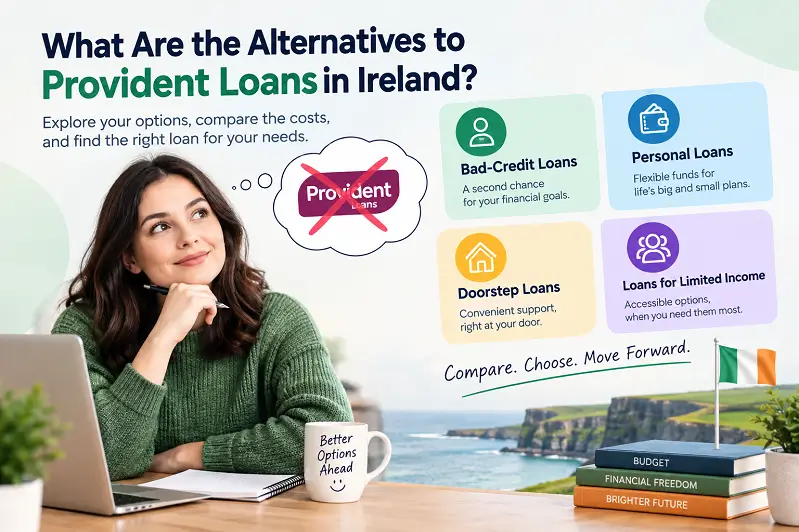
If you are looking for alternatives to Provident loans in Ireland, there are borrowing options you may come across, including bad-credit loans, personal loans, doorstep loans, and other small loan options. However, these products are not identical. The right choice depends on your income, existing commitments, affordability, and the total cost of borrowing.
Provident loans were associated with small-scale borrowing and doorstep lending where repayments could be collected through an in-person service. As these loans are no longer available in Ireland, borrowers looking for options need to consider other forms of credit.
Before taking out any alternative, look beyond how you can receive the money. The APR, repayment period, amount repayable, fees, and your ability to maintain the repayments should all be considered.
Provident was known for offering small loans through a doorstep lending model. This meant customers could deal with a representative in person and make repayments according to the agreed arrangement.
That model appealed to some borrowers who preferred face-to-face service, particularly when they needed a small amount of money.
However, borrowers looking for this type of finance in Ireland now need to consider products. Depending on their circumstances, these could include bad-credit loans, personal loans, doorstep loans or other forms of short-term borrowing.
The important point is that an alternative loan should not be chosen simply because it looks similar to the product you previously used. The cost, repayment structure, and eligibility requirements can be different.
There is no replacement that will suit every borrower. Different loan types have features, costs, and eligibility requirements.
Here are some options you may want to consider.
1. Bad-credit loans
Bad credit loans are designed for borrowers whose credit history may make it more difficult to qualify for some mainstream lending products.
Having a poor credit history does not automatically mean that you will be approved for a loan. A lender may consider your income, existing debts, repayment history, affordability, and other financial information before making a decision.
The cost of borrowing can also vary between lenders and applicants. Therefore, do not assume that a particular loan will be affordable simply because you can qualify for it.
If you are considering a bad-credit loan, look carefully at the APR, monthly or weekly repayment, loan term, and total amount repayable.
For an Ireland-focused borrower, MyCreditBucks provides loan options, including bad-credit loans and other borrowing options. You should always check the eligibility requirements and loan terms before applying.
2. Personal loans
A personal loan may be another option if you need to borrow an amount or want more flexibility over how you use the money.
Unlike vehicle finance, a personal loan can generally be used for permitted purposes such as buying a car, paying for a major expense, or dealing with another financial need, subject to the lender's terms.
The amount you can borrow and the repayment period will depend on the lender and your financial circumstances.
Personal loans can also have interest rates and repayment structures, so compare the total cost rather than focusing only on the monthly payment.
A longer repayment period may make the monthly instalments more manageable. It can also increase the amount of interest you pay over the full term.
3. Doorstep loans
Doorstep loans are another form of borrowing associated with the in-person lending model that many people previously connected with Provident.
The main difference is the way the service operates. Depending on the product, a borrower may receive an in-person service for the delivery or collection of repayments.
For borrowers who prefer face-to-face interaction, this may be an option to investigate.
However, convenience can come with costs. Before accepting a doorstep loan, check the APR, repayment schedule, fees, collection arrangements and total amount repayable.
MyCreditBucks currently lists doorstep loans among its loan options. The available amount, cost, and eligibility criteria should be checked directly before applying because these terms can change.
Having a limited or irregular income can make borrowing more difficult because lenders need to assess whether you can afford the proposed repayments.
If you are unemployed, working part-time, receiving a pension, or relying on another regular source of income, the lender may consider your financial circumstances as part of its affordability assessment.
However, there is no loan amount or interest rate for someone with limited income. Each lender has its own eligibility and affordability criteria.
When searching for a loan based solely on your employment status, focus on whether the repayments would fit comfortably into your budget.
If your income already goes towards household expenses and existing debt repayments, taking on another loan could put additional pressure on your finances.
The answer depends on what you need the money for, how much you need, and what repayment you can realistically afford.
| Loan option | May suit | What to compare | Main consideration |
| Bad-credit loan | Borrowers with a weaker credit history | APR, repayment and total cost | Interest and eligibility can vary between lenders |
| Personal loan | Borrowers who need a more flexible borrowing option | APR, loan term and total repayment | A longer term can increase the overall cost |
| Doorstep loan | Borrowers who prefer an in-person service | Fees, repayment structure and APR | Convenience may come with additional costs |
| Limited-income borrowing | People with regular but limited income | Income requirements and affordability | The amount available may depend on repayment capacity |
| Non-loan alternatives | People who cannot comfortably afford new debt | Existing commitments and other options | Avoids taking on another monthly repayment |
The table shows why there is no one-for-one replacement for Provident loans. Your circumstances should determine which options are worth investigating.
Not necessarily.
A different loan may appear cheaper because its monthly repayment is lower. That does not automatically mean you will spend less overall.
For example, extending the repayment period can reduce the amount you pay each month. However, you may pay interest for longer, increasing the amount repayable.
Before accepting an alternative, compare:
The cheapest-looking monthly payment is not necessarily the lowest-cost borrowing option.
It may be possible to apply for a loan with a poor credit history, but approval is not guaranteed.
Lenders can assess information such as your income, existing financial commitments, repayment history, and overall affordability when considering an application.
There is also no credit score that determines whether every Irish lender will approve or reject an application. Different lenders can apply their own lending criteria.
This means you should avoid assuming that a particular credit history will automatically qualify you or prevent you from borrowing.
If you are considering a loan, check the lender's eligibility requirements and make sure you can afford the repayments before applying.
Before signing a loan agreement, take a minute to understand exactly what you are committing to.
Check the APR
The APR can help you compare the cost of different borrowing options. However, also check the amount repayable because this shows what you are expected to repay over the full term.
Check the repayment period.
A longer term can reduce your repayment, but it may increase the overall interest cost.
Check the total cost.
Do not compare loans using the repayment alone. Look at the amount you will repay, including applicable fees and interest.
Check the repayment schedule.
Find out whether repayments are weekly, fortnightly, or monthly and make sure the payment date works with your income.
Check the fees
Read the agreement for administration fees, late-payment charges, and any other applicable costs.
Check affordability
After paying rent or mortgage, household bills, food, transport, and existing debts, you should know how much you can realistically afford to put towards another loan.
The fact that a lender is willing to offer an amount does not necessarily mean that borrowing the maximum amount is suitable for your budget.
Taking another loan is not always the answer.
If your existing repayments are already difficult to manage, adding another monthly commitment could increase pressure.
Before borrowing, consider whether the expense can be delayed, reduced, or paid from existing savings without leaving you unable to cover costs.
You could also contact your existing lender if you are struggling with repayments and ask what options may be available under your agreement.
The key question is not simply:
“Can I get another loan?”
It is:
“Can I afford to repay this loan without creating a financial problem?”
Doorstep lending is still a type of borrowing that some consumers may encounter, but you should check the current availability, lender authorization, and product terms before applying.
If you are specifically looking for an in-person borrowing service, compare the costs carefully against other personal loan options.
Convenience should not be the reason for choosing a particular loan.
MyCreditBucks provides loan options for borrowers in Ireland, including personal loans, bad-credit loans, doorstep loans and debt-consolidation loans.
The specific amount, APR, and repayment terms for an applicant depend on the product and the lender's assessment.
If you are thinking about something other than Provident loans, you can look at the current MyCreditBucks loan options and check the conditions against other borrowing choices that are available. The important thing is to know all the costs before you agree to anything.
Are Provident loans still available in Ireland?
Provident loans are not available in Ireland anymore. People who are looking for kinds of small loans need to think about other loan products and other choices.
What can I use a Provident loan for?
Depending on what's happening in your life, you might think about a bad-credit loan, a personal loan, a doorstep loan, or another way to borrow money. If you do not feel like you can handle another loan, there might be options that do not involve borrowing.
Can I get a bad-credit loan in Ireland?
You can try to apply for a bad-credit loan. Whether you get approved depends on the rules of the lender and if you can afford it. Your money coming in, what you already owe, and your money history could be looked at.
Are doorstep loans available in Ireland?
Some companies might offer doorstep loans. Make sure to check what the lender is offering, what the terms are, what the fees are, and what the repayment rules are before you apply.
What should I compare before taking a loan?
Look at the APR, how much you will pay back in total, how long the repayment period is, how much you pay each time, any fees, what happens if you pay late, and if the payments fit into your budget.
Can I get a loan if I have income?
It might be possible based on what the lender's looking for and your overall money situation. The main thing is if the payments you are thinking about making are something you can handle based on your income and what you already owe.
Is a Provident loan alternative cheaper?
No. Another loan might have an APR, a different repayment term, and different fees. Always check how much you will pay back in total, rather than thinking that a different product is cheaper.
If you are looking for something other than Provident loans in Ireland, there are several choices to look into, including bad-credit loans, personal loans, doorstep loans, and options for people who do not have much money.
However, there is no single replacement for Provident loans.
The best choice depends on how much you need, why you need it, what you can afford to pay, and how much the loan will cost in total.
Before you apply, compare the APR, how long it takes to pay back the loan, and how much you will pay in total. If the payments you are thinking about making would add stress to your expenses or what you already owe, think about whether taking on another loan is the right choice.
If you decide that borrowing is the thing for you, check the current MyCreditBucks loan options and compare the terms carefully before you agree to anything.

Kiera Naylor is the Finance Content Manager at MyCreditBucks, where she helps readers make sense of personal finance, borrowing options and loan-related topics. She focuses on creating clear, practical and reader-friendly content that explains loan costs, repayment terms, eligibility requirements and responsible borrowing.
Kiera believes that understanding your financial options is an important step towards making informed borrowing decisions. Through her work at MyCreditBucks, she aims to make financial information easier to understand and help readers explore their options with greater confidence.
